

The EU’s approach to corporate taxation in a changing international environment
2026-10-06
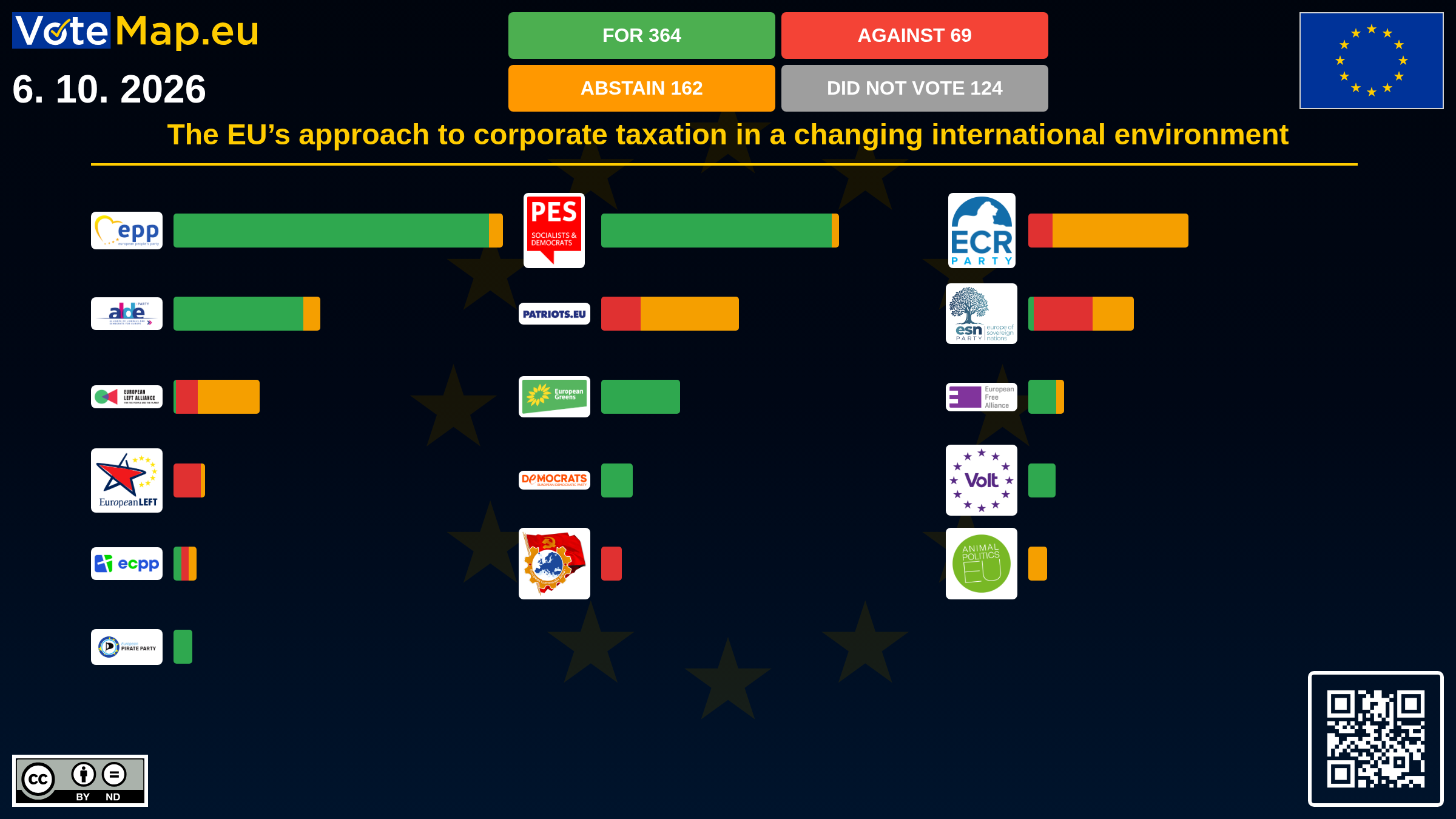
The resolution on how the EU should approach corporate taxation was adopted by 364 votes to 69, with 162 abstentions. It was unanimously supported by the EPP, S&D, Renew and Greens/EFA; almost the entire ESN voted against it, whilst the ECR and PfE mostly abstained. The abstentions came mainly from the ECR and PfE: 105 out of 162. Among other things, the Parliament calls on the Commission to assess the impact of the ‘Side-by-Side’ agreement, which, according to the resolution, favours US multinationals over their European counterparts. The rapporteur was Kinga Kollár (EPP).
The European Parliament in Strasbourg adopted a resolution on the EU’s approach to corporate taxation in a changing international environment. This is an own-initiative report (INI) drawn up by the Committee on Economic and Monetary Affairs (ECON). The rapporteur was Kinga Kollár of the European People’s Party (EPP).
A large part of the resolution concerns the global minimum tax, known as Pillar II. The Parliament regrets that major economies such as China and India have not yet introduced it, and wants the EU to support its wider implementation worldwide (paragraph 4). It is concerned about the ‘Side-by-Side’ agreement of January 2026, which the Commission confirmed in a communication dated 12 January 2026. According to the resolution, this effectively exempts US multinational companies from most of the obligations under Pillar II, whilst companies based in the EU are fully subject to them, thereby placing them at a competitive disadvantage. The Commission should urgently assess the impact of the agreement, including any potential shortfalls in Member States’ revenue, and propose solutions (points 5–7). The Commission should make full use of state aid rules and anti-subsidy instruments to counter tax advantages that harm European companies (point 8).
The resolution further calls on the Commission to compare, on an annual basis, the effective tax rates of EU and non-EU companies operating in the single market and to propose corrective measures where necessary (point 11). It aims to simplify and harmonise EU tax rules where they overlap. Member States should simplify reporting requirements, but without undermining tax transparency and anti-tax avoidance rules (points 15–16). The Commission is to revise the BEFIT proposal – the Common Corporate Tax Base – and align it with Pillar II. If negotiations in the Council do not progress, it is to put forward a more focused proposal, proceeding step by step (point 17). The resolution calls on the Council to resume negotiations on the reform of the EU list of tax havens and the Code of Conduct. The Commission and the Member States are to enhance transparency regarding beneficial ownership and impose stricter penalties on non-cooperative jurisdictions (paragraphs 23–24). Member States are to speak with one voice within the OECD and the UN (paragraph 30).
The resolution was adopted by 364 votes in favour and 69 against, with 162 MEPs abstaining. Of the 595 who voted, more than a quarter were neither in favour nor against.
The pro-European majority voted unanimously in favour: the EPP with 147 votes, the S&D with 106, Renew with 63 and the Greens/EFA with 46. None of these groups voted against. Five MEPs from the EPP, six from Renew and three from the S&D abstained. None of the four groups issued a separate statement on the vote, so their position is reflected by how they voted. In this vote, the EPP did not vote alongside the far right.
The far right was not unanimously opposed. Only Europe of Sovereign Nations (ESN) stood clearly against the motion: 20 of its 21 voting members voted against, whilst one abstained. The European Conservatives and Reformists (ECR) and Patriots for Europe (PfE) mostly abstained. Within the ECR, 61 out of 71 voting members abstained and 10 voted against; within the PfE, 44 out of 62 abstained and 18 voted against. No one from either group voted in favour, and together they accounted for 105 out of 162 abstentions.
The Left largely abstained (27 MEPs), with 14 voting against and one in favour.
The pro-European majority was divided over an amendment intended to be inserted after point 30. It was not tabled by any political group, but by a group of individual MEPs. The S&D (120), Greens/EFA (49) and The Left (42) voted in favour. The majority of the EPP (141 against, 11 in favour), the majority of Renew (51 against, 16 in favour), and the ECR, PfE and ESN were against, with not a single vote in favour. The amendment was rejected by a vote of 247 to 347, with 38 abstentions. The EPP voted alongside the far right on this issue, and the rejection was decided by the votes of the ECR, PfE and ESN, as the motion would have secured a majority without them. We do not yet know what the motion contained, as we have not obtained the text.