

Temporary Fund for Sectors at Risk from the Carbon Border Adjustment Mechanism
2026-09-15
Parliament today, by a vote of 433 to 97 (with 146 abstentions), adopted its position at first reading on the Temporary Decarbonisation Fund – a complementary instrument to the Carbon Border Adjustment Mechanism (CBAM), designed to help European manufacturers cope with the phase-out of free emission allowances. This constitutes a mandate for negotiations with the Council, not a dispute with it: the Council has not yet taken a position on the proposal. All four centre-left groups voted in favour, whilst the far right voted against. The turnout of 94.3 per cent was the highest of all Tuesday’s final votes.
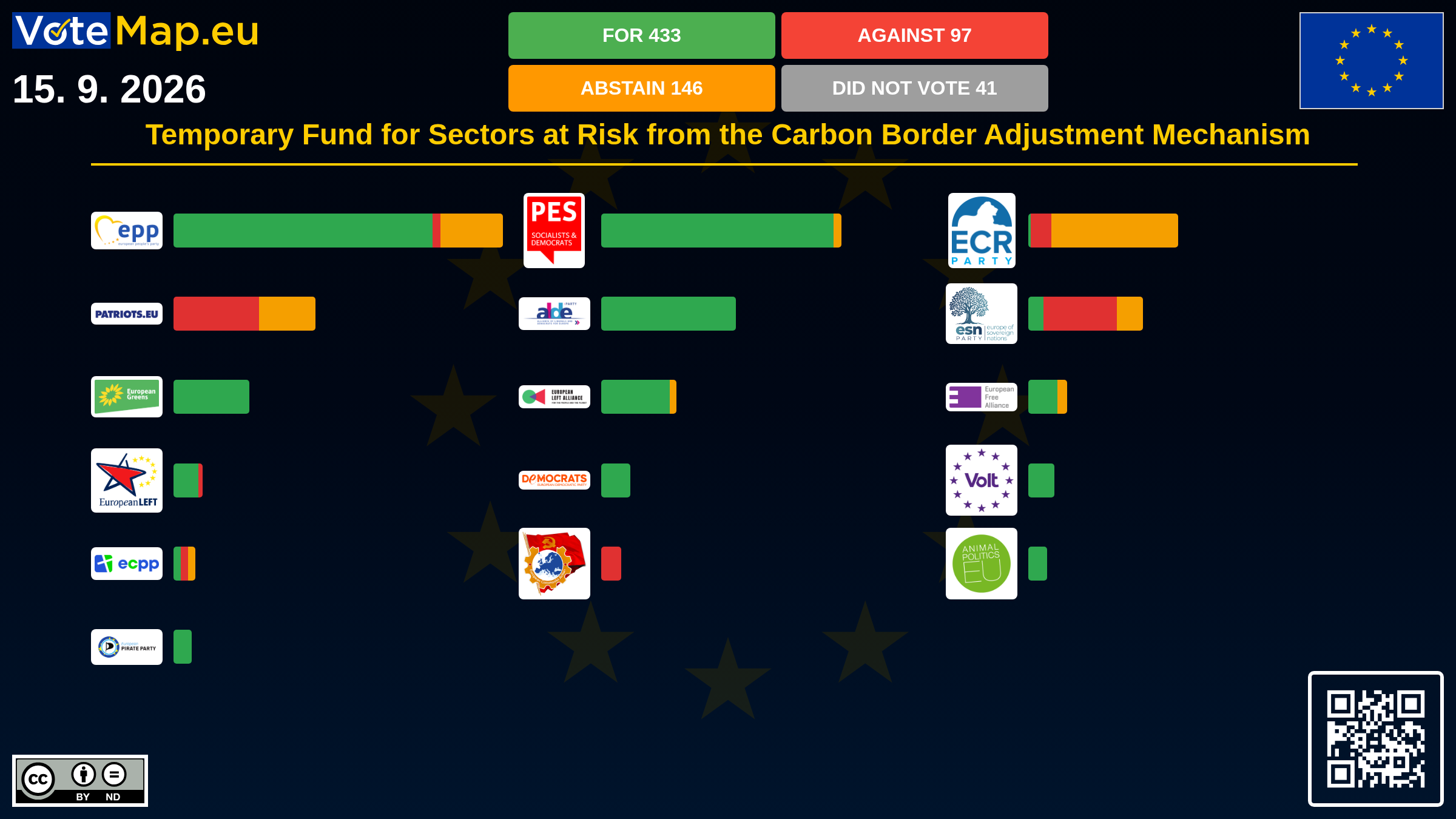
Members of the European Parliament today adopted their position at first reading on the proposal to establish a temporary decarbonisation fund – an accompanying instrument to the Carbon Border Adjustment Mechanism (CBAM). This vote merely marks the start of negotiations with the Council: it constitutes a mandate for the forthcoming negotiations with Member States, whilst the Council has not yet adopted a position on this specific proposal.
The fund is intended to provide temporary support to European producers of goods subject to the CBAM and to mitigate the risk of so-called carbon leakage, i.e. the relocation of production outside the EU due to the cost of emissions. It is to be financed by 25 per cent of Member States’ revenue from the sale of CBAM emission allowances for the years 2026 and 2027, which, according to the European Commission’s estimate, should yield around 633 million euros. The fund is a response to the fact that, at the same time, the EU is gradually phasing out free emission allowances for sectors covered by the CBAM – aluminium, fertilisers, iron and steel – so that European producers are placed at a disadvantage compared to competitors from countries without a comparable carbon price.
Compared with the European Commission’s original proposal from December 2025, the Parliament, in a report by the Committee on the Environment (rapporteur Pascal Canfin, Renew) secured longer and earlier support – payments as early as 2027 to 2029 instead of a single round in 2028 – an expansion of the scope of beneficiaries to include fertilisers and companies that further process goods covered by the CBAM, and a different allocation of unused funds: rather than being returned to Member States, they should be channelled towards the EU’s international climate commitments under the Paris Agreement.
Rapporteur Pascal Canfin (Renew) stated that the proposal broadens the range of products covered by the duty, introduces stricter rules against circumvention – including the relocation of production from China – and offers solutions for farmers as well as an export scheme for European companies.
All four major democratic groups voted in favour, virtually unanimously – the S&D, Renew Europe and Greens/EFA with not a single vote against; the EPP voted almost unanimously in favour, with only a few votes against and some MEPs abstaining. The far right opposed the motion, but not uniformly: the ESN voted against it almost unanimously and with full participation, whilst the picture was different for the ECR and PfE – the overwhelming majority of the ECR preferred to avoid the vote by abstaining, and only a minority voted explicitly against; similarly, though to a lesser extent, a significant proportion of the PfE abstained. The far right thus presented itself as a coordinated bloc against the proposal, but for two of the three groups, the stance was more one of evasion than of unequivocal rejection.
Voting turnout reached 94.3 per cent (676 out of 717 MEPs) – the highest of all the final votes during that Tuesday’s sitting. The ESN had the highest turnout (100 per cent), whilst the PfE had the lowest (88.1 per cent).